Imagine that you are conducting a search on the Internet for a pair of sneakers that you have been interested in for a while. You’re thinking about purchasing them now or waiting for payday, and you are hovering over the “Add to Cart” button. All of a sudden, you see a small amount of red text just beneath the size selector: “Only 2 pairs left in your size!”. In just a few seconds, your hesitation evaporates, your credit card is out and the purchase is made.
Why do we do this? Why do we keep putting things off and put off purchases for days just to do them the moment we get a feeling of urgency?
The solution is in human psychology. Analysis paralysis, budget hesitation, and distraction are just a few reasons that customers will procrastinate on making a purchase. To stop this momentum, companies employ psychological triggers to subtly influence customers from looking to purchasing.
The two most potent psychological motivators in a marketers arsenal are scarcity and urgency. They may appear as two sides of the same coin, but they have different impacts on customer behavior. Knowing the scarcity vs urgency marketing is crucial for any company seeking to strengthen the conversion optimization of its digital marketing campaign and convert browsers into loyal customers.
1. Understanding Scarcity Marketing
What Is Scarcity Marketing?
Scarcity marketing is basically about the law of supply and demand whereby people like what they want that’s unavailable within the vast majority of ways. It is a technique that is based on the concept of scarcity. The lesser the perceived scarcity of a product, service or opportunity, the greater its perceived value. Scarcity marketing strategies help marketers convey to the buyer that if they don’t take action right this moment then that particular product might not ever be offered to them again.
Examples of Scarcity Marketing:
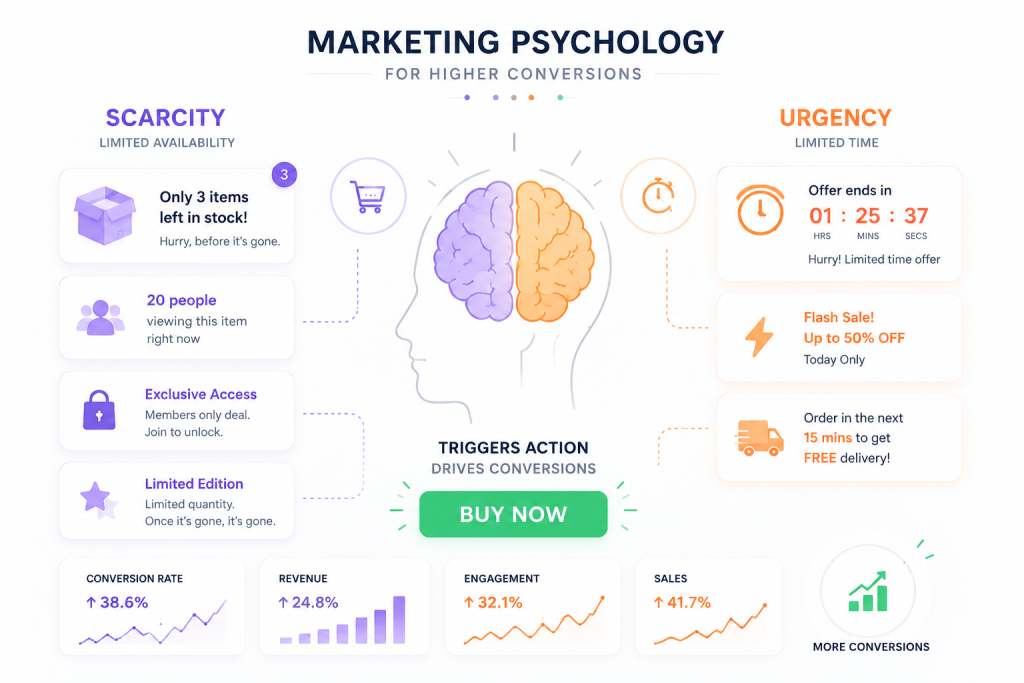
- “Only 3 items left”: Commonly seen on e-commerce giants like Amazon to show low inventory.
- Limited edition products: Brands like Nike or Supreme releasing a fixed number of sneakers or apparel items.
- Exclusive membership access: Private communities or beta software tests that only accept a handful of users.
- Seasonal collections: Pumpkin spice lattes in the autumn or holiday-themed packaging.
Why Scarcity Works
Scarcity experiments demystified are intertwined with human history. We have an innate inclination towards valuing scarce resources. In today’s “consumer behavior” this is how it looks: Fear of Missing Out (FOMO). If something is rare, we think that it must be good because everyone else is purchasing it.
Moreover, a state of competition is established because of scarcity. You’re not merely purchasing a product, you’re winning it ahead of anyone else.
Key Benefits:
- Creates product desirability: Rarity elevates a product from a commodity to a luxury.
- Increases faster decision-making: Eliminates the “I’ll think about it” mindset.
- Boosts perceived exclusivity: Makes the buyer feel special for successfully acquiring the item.
Note: Executing scarcity effectively requires a clean website layout. If your site looks cluttered, scarcity can feel cheap. Investing in high-quality CRO Design ensures your limited-quantity alerts look professional and persuasive. By aligning your scarcity cues with the fundamental Psychology of the CTA, you ensure your call-to-action acts as a natural escape valve for the buying tension you’ve created.
2. Understanding Urgency Marketing
What Is Urgency Marketing?
While scarcity focuses on how much is available, urgency focuses on how fast the consumer must act. Urgency marketing is a strategy built around time-sensitive offers. It relies on deadlines to push users to act quickly, leveraging the human tendency to procrastinate until the very last minute.
Common Urgency Marketing Examples:
- Countdown timers: Visual clocks ticking down hours, minutes, and seconds on a landing page.
- Flash sales: Deep discounts that last for a very brief window (e.g., “4-Hour Flash Sale”).
- “Offer ends tonight”: Clear, time-bound headlines in email marketing campaigns.
- Same-day shipping discounts: “Order within the next 14 minutes to get it by tomorrow.”
These urgency marketing examples show how powerful a ticking clock can be when it comes to breaking customer inertia.
Why Urgency Drives Conversions
Deadlines reduce hesitation by eliminating the luxury of time. When an offer has no expiration date, shoppers add items to their carts and leave, thinking they will return later. Most never do. Urgency forces instant decision psychology into play, shifting the consumer from rational, prolonged deliberation to emotional buying behavior.
Key Benefits:
- Faster purchasing decisions: Shortens the sales cycle drastically.
- Reduced cart abandonment: Gives users an immediate reason to check out right now.
- Increased short-term sales: Perfect for hitting revenue targets during seasonal dips.
Pro Tip: To maximize the impact of urgency, your final purchase button needs to stand out perfectly. Check out CTA button design best practices to ensure your deadline matches a compelling button, and utilize color psychology for conversions to select high-contrast colors (like vibrant reds, oranges, or blues) that trigger immediate action without causing visual fatigue.
3. Scarcity vs Urgency Marketing: Key Differences
To deploy these strategies effectively, you must understand how they diverge in focus, psychological impact, and execution.
Feature | Scarcity Marketing | Urgency Marketing |
|---|---|---|
Primary Focus | Quantity (How many are left?) | Time (How much time is left?) |
Core Emotion | Exclusivity & FOMO (Fear of being left out) | Speed & Anxiety (Fear of losing a deal) |
Value Impact | Increases the perceived value of the product | Increases the speed of the transaction |
Best Used For | Premium, luxury, or high-ticket items | Mass market, sales, clearance, and e-commerce |
Simple Real-Life Examples
- Scarcity Example: “Only 2 seats left for the VIP mastermind webinar.”
- Urgency Example: “Registration for the webinar closes in 2 hours.”
The Psychological Distinction
The scarcity message influences customer psychology by targeting value perception. It implies that the webinar is highly sought after and prestigious. The urgency message, on the other hand, creates emotional pressure based on a ticking clock. It doesn’t necessarily mean the webinar is exclusive; it simply means the door is closing.
4. Which Strategy Converts Better?
The Answer Depends on Your Business Goals
There is no definitive winner in the battle of scarcity vs urgency; rather, each strategy excels under different circumstances. Selecting the right one depends entirely on your specific conversion optimization strategies.
- Scarcity Performs Better When:
- Selling premium or high-ticket products: Luxury buyers are driven by status and exclusivity, not cheap discounts.
- Launching limited editions: Perfect for collectibles, art, or specialized SaaS tiers.
- Building long-term brand equity: Position your brand as a high-demand commodity.
- Urgency Performs Better When:
- Running promotional sales campaigns: Ideal for Black Friday, Cyber Monday, or holiday clear-out events.
- Increasing quick purchases: Works beautifully for low-to-medium-priced e-commerce items.
Boosting e-commerce checkout speed: Eliminates lingering cart abandoners.
What Studies and Marketers Commonly Observe
In isolation, data from marketing psychology for conversions shows that urgency often generates a higher volume of rapid conversions, while scarcity drives higher profit margins per item.
However, the real magic happens when you combine the two. A blended approach triggers immediate action while simultaneously raising the product’s value.
Example Combination: “Only 5 products left at this price flash sale ends tonight!”
5. The Role of FOMO in Modern Marketing
Why Fear of Missing Out Is So Powerful
FOMO can’t be overlooked when talking about scarcity and urgency. FOMO means feeling anxious when you see people having a great time and you’re not.In layman’s terms, FOMO is the social fear that others may be having a great time without you.
The concept of FOMO marketing is closely related to modern digital marketing, as it evokes the highest level of emotional responses. We accept what we believe others believe (social proof). If someone else is taking advantage of something that we are not, we think it’s a loss. Humans are loss averse and will respond and take action to prevent that negative feeling.
Examples of FOMO Marketing in Action:
- Live purchase notifications: Small pop-ups stating, “Sarah from New York just bought this item 2 minutes ago.”
- Limited-time bonuses: “Buy within the next 10 minutes and get our premium e-book for free.”
- Waiting lists: “Join 10,000 others on the waitlist for early access.”
- Exclusive launch access: Influencer-only reveals that make the general public eager for the drop.
FOMO works exceptionally well in e-commerce and SaaS marketing because digital products and online stores move quickly. However, a marketer must always balance persuasion with authenticity. If your audience realizes your FOMO triggers are manufactured, your brand reputation will instantly plummet.
6. Best Practices for Using Scarcity and Urgency Together
Avoid Overusing Psychological Triggers
The fastest way to destroy customer loyalty is through fake scarcity and artificial urgency. If a customer visits your online store, sees a countdown timer hit zero, refreshes the page, and watches the timer restart, you have just broken their trust.
Ethical marketing practices are not just morally correct they are essential for your bottom line. Use genuine stock limits and real deadlines. If you say a sale ends on Friday, end the sale on Friday.
Tips for Better Conversion Results
To successfully integrate these triggers into your digital storefront, keep these practical tips in mind:
- Display genuine stock limits: Integrate your e-commerce inventory management tool directly with your front-end store to show live, accurate stock levels.
- Enforce real deadlines: Use tools that lock out users once a promotional window has closed.
- Keep messaging simple: Do not confuse the user with overly complicated conditions. State the limit or the time clearly.
Additionally, ensure your technical foundation is optimized. This involves adopting a seamless conversion-focused UX design that keeps the purchasing path friction-free. Your CTA placement optimization should ensure that your action buttons are always within easy reach, complemented perfectly by mobile-friendly checkout experiences that cater to the massive wave of smartphone shoppers.
7. Mistakes Businesses Should Avoid
Even the most seasoned marketers can fail with scarcity and urgency if they fall into these common traps:
- Mistake 1: Fake Scarcity
Customers are incredibly internet-savvy. They notice repetitive “Only 1 left” tricks across multiple visits. If your scarcity isn’t real, consumers will abandon your brand entirely and head to a competitor. - Mistake 2: Overwhelming Urgency
Placing blinking countdown timers, flashing red text, and pop-up banners all on a single page creates a stressful, high-pressure environment. Too much urgency induces anxiety rather than excitement, causing users to close the tab out of sheer annoyance. - Mistake 3: Poor User Experience
You can have the most compelling scarcity offer in the world, but if your website takes 8 seconds to load, has confusing layout shifts, or features a convoluted checkout process, conversions will tank.
To prevent this, businesses must maintain a clean, professional CRO Design. Prioritizing clear typography, fast-loading elements, and user-friendly website navigation ensures your psychological triggers can actually do their job.
Conclusion
Final Verdict
It’s not a matter of scarcity vs urgency, as it’s often assumed. When used properly, both strategies can be very successful in converting.
Ultimately, it will depend on your audience behavior, brand positioning and campaign objectives. Scarcity can be used to really enhance your offering and to encourage a sense of exclusivity. Be urgent when you need to compel quick action and lots of sales in the short term. Properly mix them together for a fantastic effect, without overwhelming your online shop window.
Takeaway
Avoid making assumptions about what works for your business, do the test. Run A/B testing to determine the effectiveness of your audience’s response to limited-quantity notices compared with countdown timers. Most importantly, safeguard your brand with genuine communication and user trust. Then you can establish profitable, long-term customer relationships in a responsible way with psychological triggers.
Want higher conversions? Begin testing scarcity and urgency strategies and further enhance conversion-focused UX design and CTA experience now.