

Table of Contents
ToggleTable of Contents
Quick Answer: Customer reviews increase ecommerce sales by reducing purchase risk. They give shoppers third-party proof that a product works, answer fit and quality questions before the shopper has to ask, and add fresh, keyword-rich content that helps your pages rank in search and get cited by AI tools. Stores that collect, display and place reviews strategically across the buying journey turn hesitant browsers into confident buyers.
Imagine you are walking down a street looking for somewhere to eat. There are two restaurants next to each other. One is empty, and the staff are staring at the door. The other is busy with laughter, and there is a line of people outside.
Which one do you choose?
Nearly all go to the busy restaurant. Why? The people give the clear signal, This place is good. The shopping online functions in the same way. Your website doesn’t allow your customers to touch the products, smell them or try them on, when they make a visit. They are by nature doubtful. You have to prove them that others have taken the risk and adored the outcome and they, too, will love the product to order it and click on Add to Cart.
That is the power of ecommerce customer reviews. In this guide, we will break down exactly how reviews act as your ultimate sales tool, bridging the gap between casual curiosity and a completed purchase.
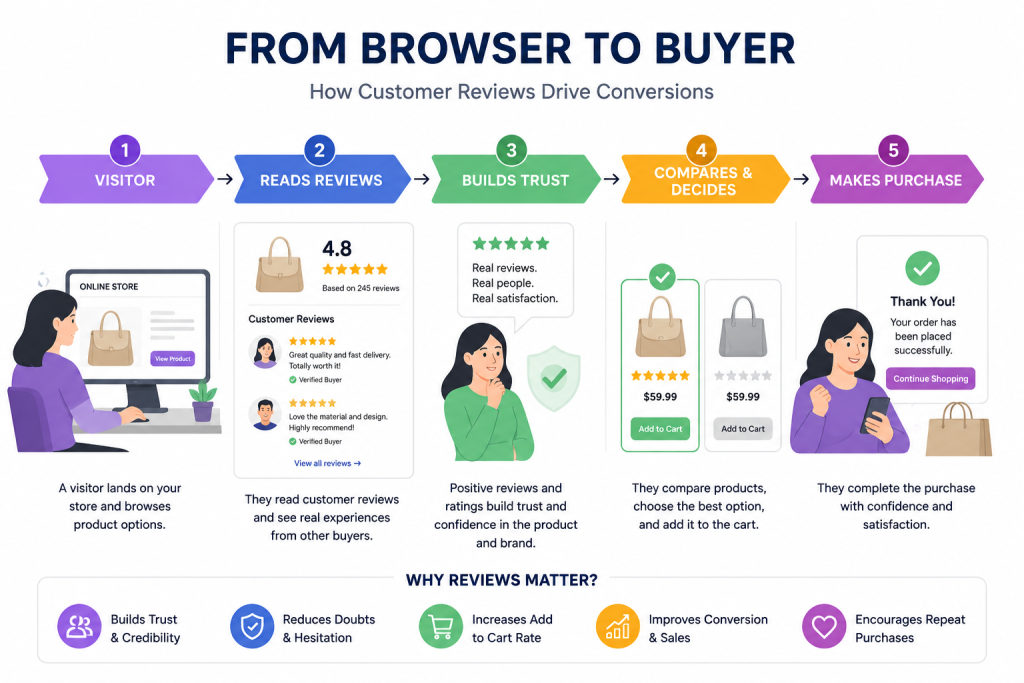
The Psychology of Trust: Why Online Reviews Influence Buying Decisions
To understand why reviews are so powerful, we have to look at human psychology. Humans are hardwired to look to others to determine the correct behavior. In the marketing world, we call this social proof.
Why do online reviews influence buying decisions?
Online reviews act as digital word-of-mouth. They reduce the perceived risk of buying from an unknown brand by providing unbiased, third-party validation that a product is high-quality and accurately described.
When a browser lands on your store, they face an invisible barrier of doubt. They wonder: Is this quality real? Will it arrive on time? Is this website a scam? Beautiful product descriptions and professional photography help, but consumers know you are biased you want their money. Customer reviews, however, are viewed as objective truths. When a shopper reads a review from someone with the same body type, the same skin concern, or the same hobby, their purchase anxiety melts away.
Three psychological forces are at work here:
- Social proof: if others bought and were happy, the choice feels safer.
- Risk reduction: reviews answer “what if it doesn’t work for me?” before the shopper has to ask.
- Similarity: shoppers trust reviewers who look like them, which is why detailed reviews that mention fit, skin type or use case work so well.
While a conversion-focused UX design structures your site beautifully and guides the user’s eyes to the right places, it is the user-generated reviews that provide the emotional validation required to close the sale. Reviews also pair well with other persuasion levers, such as the ones covered in our guide to reciprocity and loss aversion in ecommerce design.
The Data Speaks: How Customer Reviews Increase Ecommerce Sales
If you think reviews are just a “nice-to-have” feature, the data might surprise you. Research from the Spiegel Research Center at Northwestern University found that the purchase likelihood of a product with five reviews was about 270% higher than that of a product with no reviews. The effect was even stronger for higher-priced products, where the risk of a wrong choice feels bigger.
Here is a quick summary of what the research shows:
Finding | What it means for your store | Source |
|---|---|---|
Products with 5 reviews are about 270% more likely to be purchased than products with none | Even a handful of reviews makes a big difference, so don’t wait for hundreds | Spiegel Research Center, Northwestern University |
Purchase likelihood peaks at average ratings of roughly 4.0-4.7 stars, then drops as ratings approach 5.0 | A perfect rating can look less believable | Spiegel Research Center, Northwestern University |
The conversion impact of reviews is larger for higher-priced products | Prioritize review collection on your expensive items | Spiegel Research Center, Northwestern University |
Here is exactly how customer reviews increase ecommerce sales:
1. The SEO and AI Search Advantage
Search engines like Google, as well as modern AI search tools, favor fresh, unique content. When customers leave reviews, they naturally use long-tail keywords, phrases and questions that match how real people search. This can improve your search visibility and drive free organic traffic to your store.
Reviews also give AI assistants the kind of specific, experience-based detail they like to quote, such as “runs half a size small” or “works well on dry skin”. That makes your product pages more likely to be surfaced in AI-generated answers.
2. The Power of Perfect Imperfection
You might think a negative review is a disaster, but the data says otherwise. A website with exclusively 5.0-star reviews looks suspicious to modern shoppers. Consumers actually trust a store more when it has a mix of 4.2 to 4.7-star ratings. A few mild, honest criticisms make the glowing reviews look authentic. It proves you aren’t hiding anything.
3. Reviews Handle Objections Automatically
A review that says “I was worried it wouldn’t fit, but it fits perfectly!” handles a common objection far better than your sales copy ever could. Every objection a past buyer answers is one less reason for a new shopper to leave.
Understanding the deep importance of customer reviews is a massive competitive advantage. If you are currently evaluating your website’s performance through an ecommerce CRO audit or a comprehensive website conversion audit, looking at how and where you display your reviews should be at the very top of your checklist. If your store is already getting traffic but sales are flat, our checklist of 10 questions to ask when your conversion rate is below average is a good place to start.
Why a 4.2-4.7 Star Rating Can Beat a Perfect 5.0
Most store owners panic when a 3-star or 4-star review appears. In practice, the mix of ratings is part of what makes the whole set believable.
- Mild criticism adds credibility. A review such as “Great quality, but shipping took a week” makes the five-star reviews around it more trustworthy.
- Negative reviews help shoppers self-select. Someone who needs a waterproof jacket and reads “not fully waterproof” will avoid a return later.
- How you respond matters as much as the review. A polite, helpful public reply to a negative review shows future buyers how you treat customers when something goes wrong.
So don’t hide, filter out or delete honest negative reviews. Respond to them quickly and fix the root cause if there is one.
3 Strategies to Display Reviews for Maximum Impact
Simply having reviews hidden on a separate page won’t move the needle. To maximize your product reviews and sales, you need to display them strategically throughout the buyer’s journey. Here are three proven tactics:
Strategy 1: Leverage Visual Reviews (Photos & Videos)
A picture is worth a thousand words, and in e-commerce, it is worth thousands of dollars. Encourage your customers to upload photos or videos of themselves using your product. Seeing an item in a real home, under normal lighting, or worn by a regular person creates an instant connection that studio photos cannot replicate.
If you are currently building or optimizing Social proof for Shopify store layouts, integrating visual review widgets on your homepage and product pages is one of the fastest ways to build credibility.
Strategy 2: Place Reviews Across the Entire Funnel
Don’t relegate reviews to the very bottom of your product pages. Scatter them across the entire customer journey:
- The Homepage: Feature a handful of your best “hero” testimonials.
- Near the Add-to-Cart Button: Display the average star rating right next to the price.
- The Checkout Page: Place a reassuring quote about fast shipping or great customer service right where people enter their credit card info to combat buyer’s remorse.
Here is a quick reference for where each placement does its job:
Placement | What to show | Objection it handles |
|---|---|---|
Homepage | Hero testimonials, overall rating | “Can I trust this brand?” |
Product page, near price | Average star rating and review count | “Is this product good?” |
Product page, reviews section | Photo reviews, filters by size, skin type or use | “Will it work for someone like me?” |
Cart and checkout | Short quote about shipping, service or returns | “Will I regret this?” |
This layout strategy is a fundamental pillar of high-level landing page optimization.
Strategy 3: Utilize Question & Answer (Q&A) Sections
Often, a browser doesn’t buy because they have an unanswered question. “Is this jacket waterproof or just water-resistant?” “Does this shoe run true to size?” By adding a Q&A section where past buyers can answer prospects’ questions, you remove buying friction in real-time.
How to Collect More Customer Reviews
Displaying reviews only works if you have them. Here is a simple system:
- Automate a post-purchase email. Send a review request after the customer has had enough time to use the product, usually a few days after delivery. Keep it short, with one clear button.
- Make it easy. Let customers leave a star rating with one click and add text or a photo afterward.
- Ask for specifics. Prompts such as “How did it fit?” or “What skin type do you have?” produce the detailed reviews that persuade other shoppers.
- Follow the rules. Never buy fake reviews or write them yourself. If you offer incentives, disclose them and don’t reward only positive feedback, since both can break platform and consumer-protection rules.
- Reply to reviews. Thank positive reviewers and respond helpfully to critical ones.
Start small. Even a few genuine reviews per product are enough to start moving purchase likelihood.
Quick Takeaway: How Do Customer Reviews Increase Ecommerce Sales?
If you are a busy marketer or business owner skimming this article, here is the quick breakdown of why reviews drive ecommerce conversion rate optimization:
- They Build Instant Trust: They replace the physical touch-and-feel experience with peer validation.
- They Answer Specific Questions: Real user feedback addresses practical doubts about quality, fit, and everyday use.
- They Improve Search Visibility: Continuous user-generated content feeds search algorithms, driving highly targeted traffic to your site.
- They Handle Objections Automatically: A review that says “I was worried it wouldn’t fit, but it fits perfectly!” handles a common objection far better than your sales copy ever could.
Frequently Asked Questions About Ecommerce Customer Reviews
How many reviews do you need to increase ecommerce conversions?
You don’t need hundreds. Research from the Spiegel Research Center found that products with just five reviews were far more likely to be purchased than products with none. Focus first on getting your first five reviews on your best-selling and highest-priced products.
Do negative reviews hurt ecommerce sales?
Not usually. A few honest negative reviews make your overall rating look more believable, and they help shoppers decide whether a product fits their needs. What hurts sales is a pattern of unaddressed complaints. Respond publicly and fix recurring issues.
What is the ideal star rating for an online store?
Research suggests that purchase likelihood tends to peak at average ratings of roughly 4.0 to 4.7 stars. A perfect 5.0 can look too good to be true, especially with few reviews.
Where should you display customer reviews on a product page?
Show the average rating and review count near the product title and price, then place full reviews, photo reviews and Q&A lower on the page. Add a short customer quote near the cart or checkout to reassure hesitant buyers.
How do i get more customer reviews?
Send an automated post-purchase email a few days after delivery, make the review form one click, ask specific questions, and respond to every review. Always collect reviews honestly and disclose any incentives.
Do customer reviews help SEO?
Yes. Reviews add fresh, unique, user-generated content that includes natural long-tail phrases. They can also qualify product pages for star ratings in search results when marked up correctly with structured data.
Turn Your Customers Into Your Best Salespeople
Driving traffic to your online store is only half the battle. Turning that traffic into revenue requires a foundation of trust.
You can spend a fortune on ads, but nothing speaks louder to a hesitant browser than the voice of a satisfied customer. By collecting, curating, and strategically displaying ecommerce customer reviews, you turn your past buyers into your most effective, 24/7 sales team.
Take a look at your website today. Are your reviews pulling their weight, or are they hidden away? Start small by automating an post-purchase email asking for feedback, and watch your browsers transform into loyal buyers.


