
A conundrum that many online businesses experience is that they pay thousands of dollars to get visitors to their site but sales don’t follow suit. They have visitors, but they don’t have buyers.
As you go about your attempts to resolve this, you’ll keep running into the two popular industry acronyms, UX and CRO.
Both strategies are very interconnected but are very different in purpose. By knowing the difference between UX and CRO, you can create a website your users will love, and which will continue to bring in revenue. The top sites on the web do not opt for one or the other, they opt for both.
What is the difference between UX and CRO?
UX (User Experience) is about creating a frictionless, easy, and delightful website. CRO (Conversion Rate Optimization) is a technique that takes data and testing to boost the percentage of visitors who complete a certain action (such as purchase a product or sign up for a newsletter).
What Is UX (User Experience)?
Definition of UX
UX or User Experience basically refers to the user’s perception of a website’s interaction. Imagine digital hospitality! Does the user find what they want easily or does it feel like a maze to them when they arrive at your site? UX involves all parts of the customer experience, and it is very much about the emotions, usability and satisfaction felt by the customer.
Key Elements of Good UX
Great UX is often invisible users only notice it when it’s missing. The core pillars of high-quality UX include:
- Easy navigation: Simple menus that make sense intuitively.
- Fast loading speed: Pages that open instantly so users don’t get annoyed.
- Mobile responsiveness: A design that looks and works perfectly on smartphones.
- Clear content structure: Using headers and spacing so text is easy to read.
- Accessibility: Making sure the site is usable for everyone, including people with visual impairments.
Why UX Matters for Business Growth
Investing in UX keeps people on your site longer. It lowers your bounce rate (the percentage of people who leave after viewing just one page), builds deep customer trust, and keeps people coming back. When brands adopt a conversion-focused UX design philosophy, they build a stellar brand reputation while subtly setting the stage for future sales.
What Is CRO (Conversion Rate Optimization)?
Definition of CRO
Conversion Rate Optimization, or CRO, is the scientific method of digital marketing. It is the process of optimizing your website to increase the likelihood that a visitor will complete a specific goal. A “conversion” isn’t always a sale; it can be an email sign-up, a form submission, or a software download.
Common CRO Activities
CRO professionals look at data, form hypotheses, and run experiments. Common activities include:
- A/B testing: Showing version A of a page to half your visitors and version B to the other half to see which performs better.
- CTA optimization: Tweaking the text, color, and placement of your “Buy Now” buttons.
- Landing page improvements: Removing distractions so users focus on one offer.
- Checkout & form optimization: Making it as easy as possible for people to type in their payment details.
Benefits of CRO for Online Businesses
The biggest Benefits of CRO boil down to efficiency and profit. CRO allows you to generate more revenue from the exact same amount of traffic you already have. Instead of spending more money on expensive ads to get new visitors, you simply get better at converting the visitors who are already standing in your digital store. This lowers your customer acquisition costs and skyrockets your marketing ROI.
UX vs CRO: Understanding the Key Differences
To get a clear picture of user experience vs CRO, it helps to see how they look side-by-side.
|
Feature |
User Experience (UX) |
Conversion Rate Optimization (CRO) |
|
Main Goal |
Improve user satisfaction & ease of use |
Increase conversions and sales numbers |
|
Primary Focus |
The overall journey and feelings |
The specific action and bottom-line result |
|
Mindset |
Empathetic, psychological, holistic |
Data-driven, analytical, experimental |
Success Metrics
Because their goals differ, they track different numbers:
- UX Metrics: Bounce rate, average session duration, page views per session, and customer satisfaction scores.
- CRO Metrics: Conversion rate, revenue per visitor, cart abandonment rate, and lead generation numbers.
Approach and Strategy
The core difference lies in the question each discipline asks.
- UX asks: “Can users accomplish their goals easily and enjoyably?”
- CRO asks: “Can we encourage users to take the specific action we want them to take?”
What is UX vs CRO?
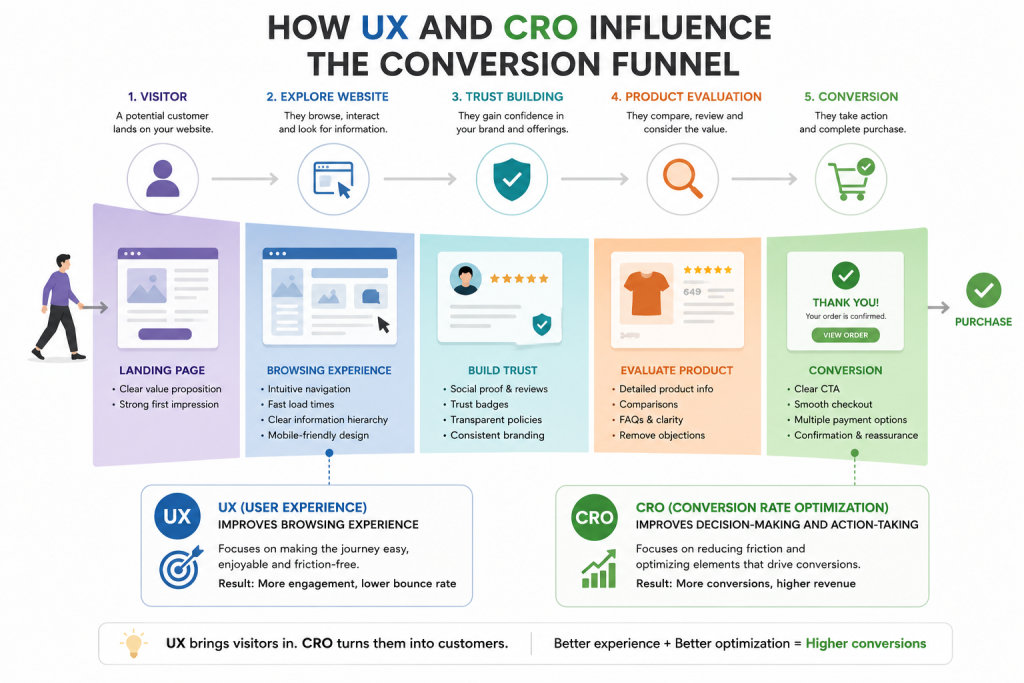
UX focuses on creating a smooth and enjoyable experience for website visitors, while CRO focuses on increasing the percentage of users who complete a desired action. UX improves usability, whereas CRO improves conversion performance.
How UX Affects Conversions
You cannot have a high-converting website without a solid foundation of usability. Understanding how UX affects conversions is crucial for diagnosing sales slumps.
Poor UX Creates Conversion Barriers
If your site is difficult to use, your visitor simply won’t bother to visit the amazing product that’s on your site. Some of the most common UX pitfalls that hurt conversions are navigation menus that are too complicated, long load times, hidden shipping costs and checkout forms with too many type-out fields.
Good UX Encourages Action
A seamless site makes users feel at ease in heading towards the checkout. Users were in a positive frame of mind, and were much more receptive to making a purchase due to the high-quality images of the products, scannable product descriptions, clean layouts and a lightning fast mobile experience.
Real-World Example
Imagine two ecommerce stores selling the exact same leather jacket for the same price with the same ad budget.
- Store A has a messy layout, tiny text, and a checkout page that errors out on mobile.
- Store B is clean, loads in under two seconds, and lets you check out with a single tap using Apple Pay.
Even with identical traffic, Store B will make significantly more money simply because its superior UX removed the barriers to buying.
Why UX and CRO Work Better Together
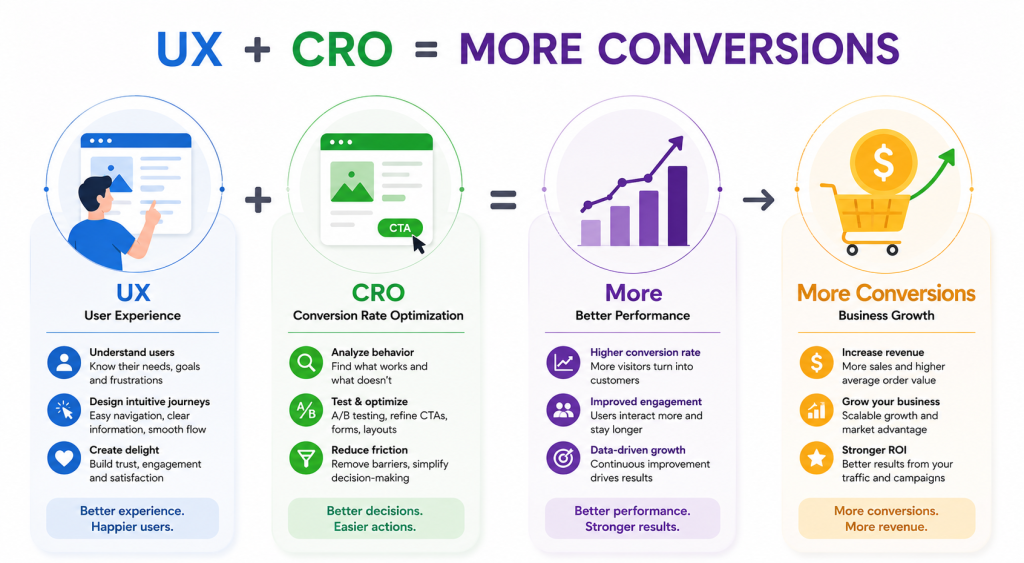
When you realize that UX and CRO work together, your website becomes an unstoppable asset. Treating them as rivals is a massive mistake.
CRO Without UX Can Hurt User Trust
If you focus purely on short-term CRO metrics without respecting UX, you risk alienating your audience. This looks like spamming users with aggressive pop-ups, countdown timers that fake urgency, and massive, flashing call-to-action (CTA) buttons. While this might get a temporary spike in sales, it destroys long-term brand trust.
UX Without CRO May Miss Revenue Opportunities
Conversely, a site built purely for UX might look like a gorgeous, minimalist digital art museum. It is beautiful and relaxing to browse, but if the “Add to Cart” button is hidden to preserve the aesthetic, or if there is no strategic call to action, your business will miss out on millions in potential revenue.
The Best Strategy: UX + CRO Alignment
True growth happens when you align both forces. UX maps out a beautiful, friction-free highway, and CRO puts up the clear, persuasive road signs that guide drivers to the right destination.
Practical Examples of UX and CRO Working Together
Let’s look at how this powerful combination works across different areas of a website.
E-commerce Product Pages
When designing a high-converting Shopify product page design, UX ensures that product images are high-resolution, zoomable, and load instantly, while also making sizing charts easy to read. CRO steps in to place an optimized, high-contrast “Add to Cart” button right above the fold (the part of the screen visible without scrolling) and adds trusted payment badges near the button to reduce buying anxiety.
Homepage Optimization
A strategic Shopify homepage design uses UX to establish a clean visual hierarchy and an intuitive navigation menu so users instantly know what the store sells. CRO enhances this by crafting a compelling headline (value proposition) and placing a direct, clear CTA button (like “Shop Best Sellers”) right in the hero banner.
Checkout Process Improvements
In the checkout line, UX contributes by introducing a clear progress indicator (Step 1 of 3) and allowing guest checkout so users don’t have to create an annoying password. CRO optimizes this layout by removing the main navigation menu entirely so users can’t click away, and adds a small section highlighting your 30-day money-back guarantee right next to the credit card field.
Tools and Experts That Help Improve UX and CRO
Improving your site requires the right toolset and, occasionally, specialized expertise.
Popular CRO Tools
To figure out where your site is losing money, you need data. Using a dedicated cro tool for shopify (such as Hotjar, Lucky Orange, or Microsoft Clarity) allows you to view heatmaps and session recordings. Heatmaps show you exactly where people are clicking, while session recordings let you watch video replays of real users navigating your site, highlighting exactly where they get stuck.
When to Work With a Specialist
If your business is growing but your conversion rates are stuck in place, it might be time to bring in professional help.
An experienced Ecom CRO Expert knows how to look past surface-level aesthetics. They use quantitative data (analytics) and qualitative data (user testing) to overhaul your site architecture. By combining advanced CRO Design principles with systematic A/B testing, they can unlock hidden revenue without requiring you to spend a single extra dollar on traffic.
Frequently Asked Questions
Is UX the same as CRO?
No. While they share the goal of improving a website, UX focuses broadly on user happiness, satisfaction, and ease of navigation, while CRO focuses strictly on driving specific business actions like sales or sign-ups.
Which is more important, UX or CRO?
Neither is more important; they are interdependent. UX creates the pleasant environment that attracts and retains users, while CRO ensures that this positive environment is optimized to generate measurable business results.
Can good UX increase conversion rates?
Yes, absolutely. By removing common technical and structural barriers such as slow loading speeds, confusing menus, and complicated layouts, good UX makes it much easier for willing customers to complete a purchase.
How do UX and CRO work together?
UX works to remove friction and frustration from the overall customer journey, while CRO analyzes user data to place strategic nudges, persuasive copy, and clear calls-to-action along that smooth journey.
Should ecommerce websites focus on UX or CRO first?
You should always build a strong UX foundation first. It makes no sense to run conversion experiments or optimize buttons on a website that is fundamentally broken, slow, or confusing to navigate.
Conclusion
At the end of the day, viewing conversion rate optimization vs user experience as a battle is a losing strategy. There are beautiful, no-cost sites on the internet and then there are ugly websites that irk people to the point of not returning.
You must have both in order to create a sustainable digital business. Review your website today with both eyes; you want to make it easy for people to use your website, and make it easy for people to take the next steps.