You have invested weeks of perfecting your product, thousands of dollars on advertisements, and hours to make your social media a perfect product. The traffic has come and your notifications of adding to cart are buzzing. However, frustratingly, something goes wrong and the sales are not corresponding to the activity. The dashboard displays lots of checkouts initiated, but only a small percentage of those users are going to the Thank You page.
This is what checkout abandonment is and to most store owners, it seems like a riddle. And why should one go to the trouble of searching a product and typing in his information, then abandon it at the last moment?
The fact is that you are probably losing money at checkout. Checkout abandonment is a revenue issue that cannot be overlooked. You have to outgrow the guessing at why people leave, to scale. You must determine the checkout drop-off points by hard data. Learning to identify checkout drop-off points in the flow of processes will enable you to eliminate sales to trivial technicalities. The best method of closing the gap between a potential buyer and a loyal customer is by using professional shopify cro techniques. This manual will demonstrate how to locate these leaks and seal them permanently.
Step 1 : Find Exactly Where Customers Are Leaving in Your Checkout
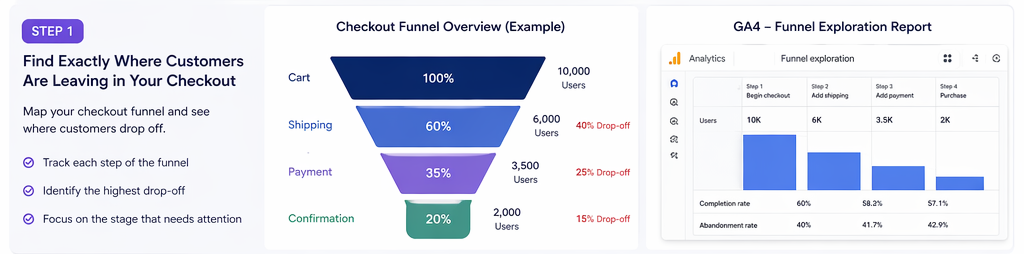
The first step to recovery is admitting you have a leak. However, you can’t fix a leak if you don’t know which pipe is bursting. Most ecommerce checkouts are a series of steps: the cart, shipping information, payment details, and the final review. To perform a proper checkout funnel analysis, you need to see the “attrition rate” at every single stage.
How to Audit Your Funnel
- Open your analytics dashboard: Whether you use Shopify Analytics or Google Analytics 4, head to your conversions or funnel reports.
- Navigate to the checkout funnel report: Look for the visualization that shows the journey from “Checkout Started” to “Session Converted.”
- Identify the “Drop-Off Cliff”: Look for the step with the highest percentage of loss.
For example, if 90% of people move from the Cart to Shipping, but only 40% move from Shipping to Payment, your shipping page is the problem. This clear data helps you avoid Shopify checkout mistakes by focusing your energy where it actually matters. Don’t waste time redesigning your payment icons if the real issue is that people are terrified of your shipping costs.
Step 2 : Use Analytics to Identify Checkout Drop-Off Points
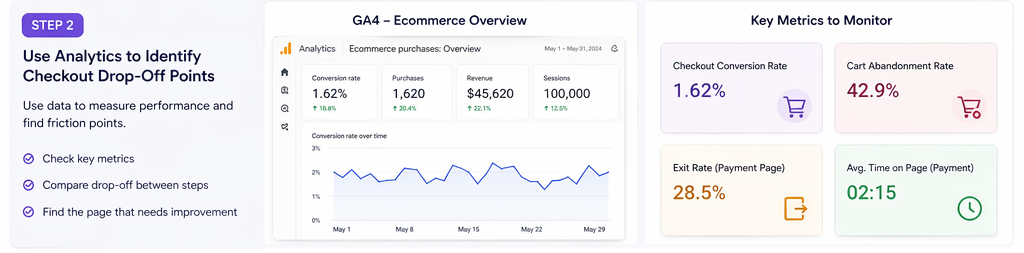
Data is only useful if you know how to read it. To truly identify checkout drop-off points, you need to look at more than just a simple count of users. You need to measure behavior to find the “friction” that causes checkout abandonment.
Metrics That Matter
When performing your checkout funnel analysis, keep a close eye on these four metrics:
- Checkout Conversion Rate: The total percentage of checkout starters who complete the purchase.
- Exit Rate: The percentage of people who leave the site entirely from a specific checkout page.
- Abandonment Rate: Specifically, those who leave items in the cart without moving forward.
- Time Spent on Page: How long are they staring at that form?
The "Confusion Formula":
If you notice a page has a High Exit Rate combined with a Long Time Spent on Page, it almost always means the user is confused. They are looking for information they can’t find, or they are struggling to understand a specific field. Using google analytics for cro allows you to see these patterns clearly, moving you from “I think people are leaving” to “I know people are stuck on the shipping method selection.”
Step 3 : Watch What Users Actually Do on Your Checkout Page
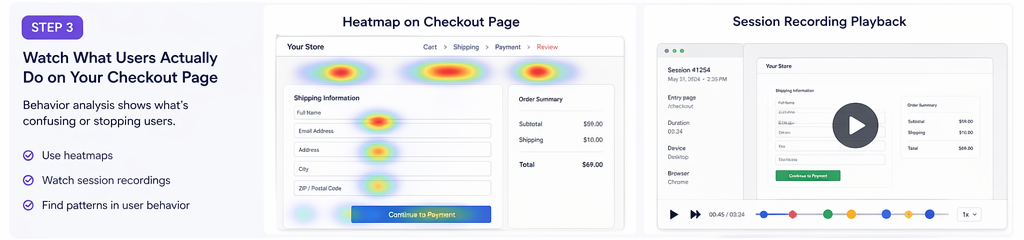
Analytics tell you the what, but behavior tools tell you the why. Sometimes, a form looks perfect on paper, but in reality, it’s a nightmare to use. To achieve peak checkout conversion optimization, you need to observe real humans interacting with your store.
Essential Behavior Tools
- Heatmaps: These show where people are clicking and scrolling. If people are clicking on a non-clickable image thinking it’s a button, you have a design flaw.
- Session Recordings: These are like a “security camera” for your website. You can watch a video of a user trying to check out.
- Click Tracking: This highlights “Rage Clicks” when a user clicks a button 10 times in a row because it isn’t responding.
Watching these recordings can be eye-opening. You might find that your mobile “Pay Now” button is hidden behind a chat bubble, or that users keep scrolling up and down the page because the total price isn’t visible. Learning How to use heatmaps for Shopify helps you reduce checkout abandonment by seeing the checkout through your customer’s eyes, not your own.
Step 4 : Identify the Most Common Checkout Problems
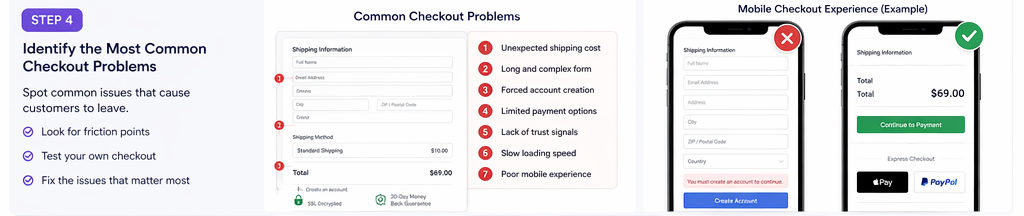
Once you’ve found the “where,” it’s time to diagnose the “why.” While every store is unique, most checkout abandonment issues stem from a handful of common culprits. Use this checklist to audit your own process:
- Unexpected Shipping Costs: 48% of users abandon carts because extra costs were too high.
- Forced Account Creation: Making someone “Register” before buying is like putting a locked gate in front of your store.
- Slow Page Loading: Every second of delay reduces conversions by up to 7%.
- Limited Payment Options: If they want to use PayPal and you only take Visa, the sale is dead.
Actionable Tip: Become the Customer
Don’t just look at your site on your high-speed office iMac. Place a test order using a three-year-old smartphone on a weak 4G connection. You might find that your Shopify homepage design is beautiful, but your checkout is so heavy that it crashes on mobile. Testing your own flow is the fastest way to reduce checkout abandonment.
Step 5 : Run Simple Tests to Confirm the Problem
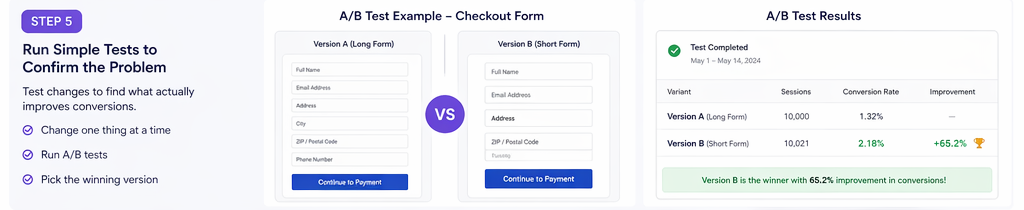
Suspecting a problem is good; proving it is better. Before you overhaul your entire checkout, you should use checkout conversion optimization tests to confirm your theories. This prevents you from making changes that might actually hurt your sales.
The A/B Testing Framework
Choose one specific problem and create two versions of the page (Version A and Version B).
- Test 1: Guest Checkout vs. Mandatory Account.
- Test 2: Single-page checkout vs. Multi-step checkout.
- Test 3: Different placements for your “Free Shipping” badge.
The golden rule of step by step A/B testing is to test only ONE change at a time. If you change the button color and the shipping price at the same time, you won’t know which change caused the result. This scientific approach is the only way to effectively reduce checkout abandonment long-term.
Step 6 : Fix the Drop-Off Points That Matter Most

You’ve found the issues and tested the solutions. Now, it’s time to implement. But don’t try to fix everything at once. Focus on the high-impact areas first usually the pages with the most traffic or the highest drop-offs.
Quick Wins for Instant Results
- Enable Guest Checkout: Let people buy now and register later.
- Display Costs Early: Don’t hide taxes or shipping until the final click.
- Reduce Form Fields: If you don’t need their phone number or middle name, don’t ask for it.
- Add Trust Badges: Display SSL certificates and “Money Back Guarantee” icons near the payment button.
- Optimize for Mobile: Ensure the “Next” button is large and easy to hit with a thumb.
These fixes directly support checkout conversion optimization by removing the “thinking” from the process. The less a customer has to think, the more likely they are to buy.
How to Continuously Monitor Checkout Performance
Identifying drop-off points isn’t a “one-and-done” task. As you add new apps, change your theme, or update your shipping rates, new leaks can appear. You must treat your checkout funnel analysis as a recurring health check for your business.
Your Optimization Routine
- Weekly: Check your overall checkout conversion rate. If it drops suddenly, something broke.
- Monthly: Perform a deep dive into your identify checkout drop-off points reports to see if new patterns are emerging.
- Quarterly: Run a fresh A/B test on a core element of your checkout.
E-commerce is a game of inches. Staying on top of your performance ensures that your store remains a conversion machine, even as your traffic grows.
What You Should Do Today
The difference between a struggling store and a profitable one often comes down to the checkout. Businesses that identify checkout drop-off points early can reduce checkout abandonment and increase revenue without spending a single extra dollar on advertising.
Your Action Plan for Today:
- Open your Shopify or Google Analytics dashboard.
- Find your checkout funnel visualization.
- Identify the step where the most people are leaving.
- Look for one common problem (like hidden shipping costs or a long form).
- Fix that one issue and start monitoring the results.
Stop letting your hard-earned traffic walk away at the finish line. Start optimizing today, and watch your revenue grow.