
With the hyper-competitive nature of digital commerce, one of the questions that business owners are never free to ask is which marketing channel is best for the bottom line of the business. The vast majority of brands either result in a binary of should we rank on Google through SEO, or should we buy our way to the top through Paid Ads?
Although both are vital, there exists an unspoken killer of revenue, lurking right before our eyes: the leaky bucket. You can introduce as much traffic as you desire into your site, but when your site does not convert you will be funding the profit margins of Google and Meta. It is at this point that most businesses fail to see the big picture. Traffic is not a sure thing that will result in revenue; only profit keeps the lights on. In order to actually scale, you should not only look at the idea of getting clicks but you should also know how a CRO Expert Company can make your current traffic a goldmine. In this guide, we are going to separate the work of SEO, Paid Ads, and CRO, their cost, and which of them, in fact, results in the greatest ROI.
What Is SEO, Paid Ads, and CRO?
We must establish the Big Three of digital growth before we can make a comparison between their earning potential. All of them have a different role within your marketing ecosystem.
What Is SEO (Search Engine Optimization)?
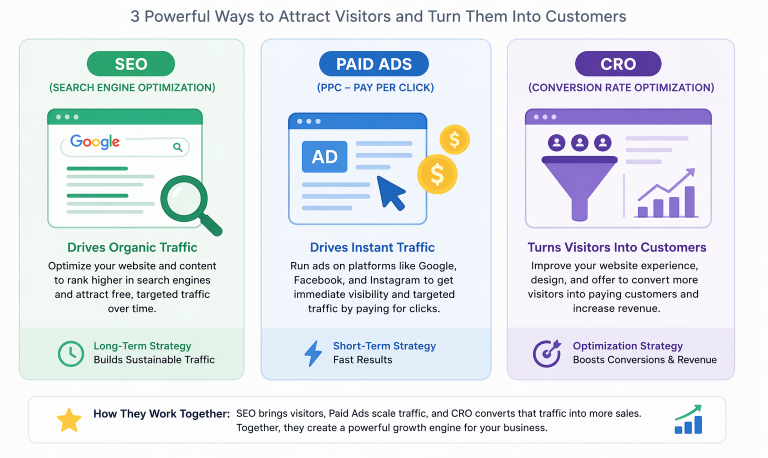
SEO is the art and science of gaining organic traffic by search engines such as Google. It is a long term drama about gaining power and significance. You do not have to pay per click as you would with ads, but rather invest in making your site high-quality, and Google will reward you with high rankings.
Key Components:
- Ranking Product Pages: Maximizing the high intent keywords in which customers are willing to purchase.
- Blogging: Educating the top-of-funnel users by offering value through educational content.
- Technical Optimization: Verifying that search engines are able to crawl and index your site.
SEO can be time-consuming, with results taking months to appear, but it builds an evergreen piece that will bring in traffic even when you aren’t spending money.
What Are Paid Ads (PPC)?
Paid Ads (also known as Pay-Per-Click, PPC) are a quick-forward button of online marketing. It is Google Search Ads, Facebook Video Ads, or Instagram Carousels, all the same, you are paying to rent a place on a platform where you can have your brand in front of a particular audience immediately.
Key Characteristics:
- Instant Traffic: It can bring you to zero visitors in one day to thousands.
- Ongoing Budget: Once you quit paying, the traffic goes away.
- Performance-Driven: The success is based on targeting, ad creative and bidding strategies.
For those wondering how to increase ecommerce revenue overnight, PPC is usually the first lever pulled.
What Is Conversion Rate Optimization (CRO)?
The CRO entails maximizing the ratio of site visitors to perform a specific action, such as a purchase, registration to a newsletter, completion of a lead form. SEO and Ads are concerned with the invitation whereas CRO is concerned with the party.
Key Examples:
- A/B Testing for Shopify: Making a comparison between two versions of a product page in order to determine which of these works best.
- Improved UX: Improving the speed and user-friendliness of the site.
- Landing Page Optimization: Having the message of your advertisements match the experience on the page to lower the bounce rates.
SEO vs Paid Ads vs CRO: Revenue Comparison
To understand seo vs paid ads which is better, we have to look at three factors: speed, cost, and the ultimate revenue ceiling.
Traffic Generation Speed
- Paid Ads (Fastest): Immediate. As soon as your campaign is approved, traffic hits your site.
- SEO (Medium/Slow): 3–18 months. It takes time for Google to trust your domain and rank your content.
- CRO (Variable): CRO doesn’t generate traffic; it maximizes it. If you already have 10,000 visitors, a Conversion Optimization process can show revenue results within weeks of implementation.
Cost Comparison
Paid Ads require a high, ongoing investment. If your Cost Per Acquisition (CPA) rises, your margins shrink. SEO requires a moderate-to-high upfront investment in content and technical fixes, but the long-term cost per lead often drops over time.
CRO, however, is often the most cost-effective. By fixing Shopify checkout mistakes, you are making your current traffic more valuable. You aren’t paying more for more people; you are simply getting more out of the people you already paid for.
Revenue Potential
SEO scales your volume. Paid Ads scale your reach. CRO scales your profit. While SEO and Ads grow the top line, CRO is the “multiplier.” If you double your traffic via SEO, you might double your revenue. But if you double your conversion rate while keeping traffic the same, you’ve doubled your revenue without increasing your marketing spend.
Why CRO Often Makes More Money Than SEO or Paid Ads
The math of CRO is undeniable. It is the only marketing activity that lowers your customer acquisition costs while simultaneously increasing your total revenue.
CRO Increases Revenue Without More Traffic
Let’s look at a basic ecommerce scenario:
- Initial State: 1,000 visitors x 2% conversion rate = 20 sales.
- After CRO: 1,000 visitors x 3% conversion rate = 30 sales.
By moving the needle just 1%, you’ve achieved a 50% increase in revenue. To get that same 50% increase via Paid Ads, you would have to spend 50% more on your budget.
CRO Improves ROI From SEO and Paid Ads
Traffic is a raw material; profit is the finished product. Without a solid landing page optimization strategy, you are essentially driving traffic to a store with locked doors. When you improve your site’s ability to convert, every dollar spent on SEO or PPC becomes more efficient. CRO acts as a rising tide that lifts all other marketing boats.
When SEO Is the Best Investment
Despite the power of CRO, you cannot convert visitors who don’t exist. SEO remains the best marketing strategy for ecommerce brands looking for sustainability.
You Want Long-Term Traffic
If you have a new website or a low-traffic site, SEO is your foundation. It builds a moat around your brand. Unlike ads, organic rankings don’t vanish if you have a bad month and need to cut spending.
You Want Sustainable Growth
SEO is ideal for content-driven businesses. By answering user questions through blogs, you build trust. This trust makes the eventual conversion much easier because the customer views you as an authority, not just a vendor.
When Paid Ads Make the Most Money
PPC is the ultimate tool for aggressive scaling and testing.
You Need Fast Results
If you are launching a new product, running a Black Friday sale, or handling seasonal inventory, SEO is too slow. You need the precision of ga4 conversion tracking setup and the speed of Facebook or Google Ads to capture demand while it’s hot.
You Have a Proven Offer
Ads make the most money when you already know your product sells. If your store has a healthy conversion rate, putting “fuel on the fire” with Paid Ads is the quickest way to hit your revenue goals.
When CRO Makes the Most Money
If you are wondering how to increase ecommerce revenue without ballooning your overhead, CRO is your answer.
You Already Have Traffic
If your site gets over 5,000–10,000 visitors a month, you are sitting on a goldmine of data. You can begin meaningful A/B Testing for Shopify to identify where users are dropping off. At this stage, a 0.5% increase in conversion is often worth more than a 20% increase in traffic.
You Want to Increase Profit Without Increasing Spend
By focusing on ecommerce psychology such as social proof, urgency, and reducing friction you can reduce your cost per acquisition. This makes your business more resilient to fluctuations in the ad market.
The Smartest Strategy: Use SEO, Paid Ads, and CRO Together
The debate shouldn’t be about which one is better; it should be about how to integrate them. This is not a competition; it is a system.
- SEO brings the high-intent, “free” traffic over time.
- Paid Ads scales your traffic during peak seasons or for specific products.
- CRO ensures that every person who arrives regardless of how they got there has the best possible chance of buying.
By ensuring your ga4 conversion tracking setup is flawless, you can see exactly which SEO keywords and which Ad sets are driving the most profitable customers, allowing you to double down on what works.
Final Verdict: Which One Makes the Most Money?
If you want the fastest traffic, Paid Ads wins. If you want the most sustainable traffic, SEO wins. But if you want the highest profit impact, CRO is the undisputed champion.
The most successful ecommerce brands don’t choose. They use SEO to build a foundation, Ads to fuel growth, and a CRO Expert Company to ensure that growth is profitable. By fixing Shopify checkout mistakes and understanding ecommerce psychology, you stop leaving money on the table and start building a business that scales effortlessly.
The Verdict: Invest in CRO first to prepare your “bucket,” then use SEO and Ads to pour in the water. That is how you maximize revenue in 2026.