
If you run a Shopify store, chances are you’ve already done the “right” things.
You launched a clean-looking website. You ran ads. You drove traffic. Maybe sales came in, but not at the level you expected.
At this point, most store owners assume the solution is more traffic.
In reality, that’s usually the most expensive mistake you can make.
After working on many Shopify stores across different industries, one thing is clear: most conversion problems are not obvious, and Shopify doesn’t warn you about them. They quietly drain revenue while everything looks “fine” on the surface.
This article breaks down the most common Shopify conversion issues and explains what proper Shopify CRO implementation actually looks like in practice.
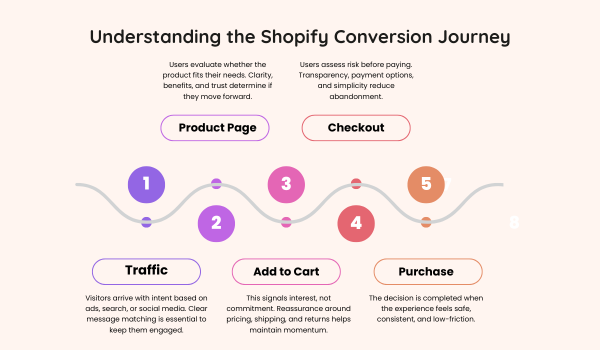
1. My Traffic Looks Fine… So Why Aren’t Sales Increasing?
This is usually the first moment store owners realize something is off.
You look at your analytics and see traffic growing. Ads are bringing clicks. Social media and SEO are working. On paper, everything looks healthy, yet revenue isn’t moving at the same pace.
What’s happening here is not a traffic failure, but a decision failure.
Visitors arrive with interest, but something interrupts their confidence. They hesitate, question, or feel unsure and then leave. CRO focuses on identifying these moments of hesitation and removing them.
A CRO expert doesn’t just look at sessions and bounce rates. They analyze:
- Where users stop scrolling
- Where they reread content
- Where they exit without interacting
These subtle behaviors reveal where your store is silently losing money.
2. You’re Optimizing the Homepage While Ignoring High-Intent Pages
Many Shopify store owners start optimization with the homepage because it feels important, it represents the brand.
But from a CRO perspective, the homepage is often not where conversions are decided.
Most buying-intent traffic lands on:
- Product pages from ads
- Collection pages from search
- Dedicated landing pages
If these pages don’t answer buying questions clearly, users won’t convert, no matter how good your homepage looks.
Effective Shopify CRO implementation prioritizes pages based on intent, not visibility. CRO experts focus first on the pages that influence add-to-cart and checkout behavior, because that’s where real revenue impact happens.
3. Product Pages That Explain the Product but Don’t Sell the Decision
Most Shopify product pages describe the product well but fail to guide the decision.
Typical problems include:
- Long feature lists with no context
- Benefits explained too late
- No clarity about who the product is for (or not for)
Customers don’t buy because a product has features. They buy because it solves a specific problem for them.
A high-converting product page does three things clearly:
- Confirms the visitor is in the right place
- Explains why this product is the best choice
- Reduces the risk of buying
This means addressing objections before they arise pricing concerns, delivery expectations, returns, quality doubts. This level of clarity is a core part of expert-level Shopify CRO work.
4. Trust Signals Exist, But They’re in the Wrong Place
Trust is not something users consciously evaluate, it’s something they feel while browsing.
Most Shopify stores already have trust elements like reviews, guarantees, and policies. The issue is rarely their absence, it’s their placement.
Common mistakes include:
- Reviews hidden far below the fold
- Guarantees placed after the CTA
- Shipping and return info only shown at checkout
Trust is most effective at the moment of doubt near pricing, near CTAs, and before commitment.
CRO experts think in moments:
- “What might the user worry about here?”
- “What reassurance would help right now?”
Repositioning trust elements alone can create significant conversion lifts without changing traffic or design.
5. Mobile Experience Is Quietly Killing Your Conversion Rate
Mobile traffic dominates most Shopify stores, yet mobile conversion rates often lag far behind desktop.
This happens because mobile users experience:
- More friction
- Less patience
- Smaller screens with higher cognitive load
Common mobile CRO issues include:
- CTAs pushed too far down the page
- Variant selectors that are hard to use
- Sticky elements covering important content
- Popups interrupting the buying flow
Using Shopify CRO tools like heatmaps and session recordings often reveals that mobile users struggle far more than store owners realize.
A CRO expert treats mobile optimization as a separate strategy, not a scaled-down version of desktop.
6. Add-to-Cart Isn’t the Problem, Checkout Is
Many store owners celebrate add-to-cart improvements, but that’s often where the real problems begin.
Checkout abandonment is one of the biggest silent revenue killers on Shopify.
Common checkout friction includes:
- Surprise shipping costs
- Unclear delivery timelines
- Missing payment options
- Confusing discount code fields that imply users are “missing out”
Each small issue adds cognitive load. Together, they increase hesitation at the worst possible moment right before purchase.
For experienced CRO professionals, checkout optimization is one of the highest-ROI activities. This is why any serious CRO expert company spends significant time analyzing checkout behavior, even on Shopify’s “optimized” checkout.
7. You’re A/B Testing Tactics Instead of Fixing Fundamentals
A/B testing is often treated as the core of CRO, but it’s usually where Shopify stores go wrong.
Many store owners start testing because it feels like progress. Changing button colors, tweaking headlines, or adding urgency badges creates activity, but not necessarily improvement. The problem is that these tests are often run before the real conversion blockers are understood.
If visitors don’t understand the value of your product, no button color will convince them. If they don’t trust the brand, a new headline won’t remove that fear. And if the product doesn’t feel relevant to their situation, even a “winning” test won’t meaningfully increase revenue.
The most common A/B testing mistakes include:
- Testing visual elements while ignoring clarity issues
- Optimizing CTAs when the offer itself isn’t compelling
- Running tests without enough data or user insight
- Declaring “wins” that don’t translate into higher revenue
Effective CRO starts with diagnosis, not experimentation. A CRO expert first studies user behavior, where users hesitate, where they drop off, and what questions remain unanswered. Only after these structural problems are addressed does A/B testing become useful.
When testing is layered on top of a strong foundation, it refines performance. When it’s used too early, it distracts from the real problems. This is why experienced CRO professionals treat A/B testing as a scaling tool, not a shortcut.
8. Your Store Looks Professional, But It Doesn’t Feel Safe
Design polish alone doesn’t build trust.
Many Shopify stores look legitimate but still feel risky to users. This often comes from:
- Generic copy that feels impersonal
- Stock images that lack authenticity
- Inconsistent messaging across pages
Trust is emotional. Users may not consciously identify the issue, but something feels off and hesitation follows.
CRO experts focus on consistency and authenticity, ensuring the entire store experience feels intentional and reliable.
9. Why Most Shopify Stores Plateau at a 1–2% Conversion Rate
Many Shopify stores hit a ceiling and can’t figure out why.
Breaking past this plateau usually requires:
- Deeper customer research
- Better message-to-market alignment
- Optimization based on behavior, not opinions
At this stage, CRO becomes less about fixing UI issues and more about understanding how customers think, compare, and decide.
This is where advanced Shopify CRO tools, qualitative insights, and expert analysis make a measurable difference.
What to Fix First If You Want More Conversions Without More Traffic
If you want the biggest impact quickly, focus on:
- Product page clarity and structure
- Mobile usability and flow
- Checkout transparency and friction
- Trust placement at key decision points
Conversion problems are not random, they are predictable and repeatable across Shopify stores.
When CRO is implemented correctly, you don’t need more traffic to grow. You simply need to help existing visitors make better, easier decisions.
That’s what real Shopify CRO is about and that’s how sustainable growth actually happens.