When you have people visiting your website yet you are not turning them into leads or sales, then you need to check the issue is not with traffic, but conversion.
There are numerous companies that pay more money to advertisements, search engines, and social media in an attempt to attract new users. However, more frequently, the more intelligent course of action is to make better what is already existing. When you follow a structured CRO process, you focus on turning existing visitors into customers instead of constantly chasing new ones.
The Conversion Optimization process isn’t about guessing what might work.It’s about understanding user behavior, identifying problems, and making smart, tested improvements that help increase your website conversion rate over time.
We may go through it step-by-step in a convenient, pragmatic manner
What Is the CRO Process?
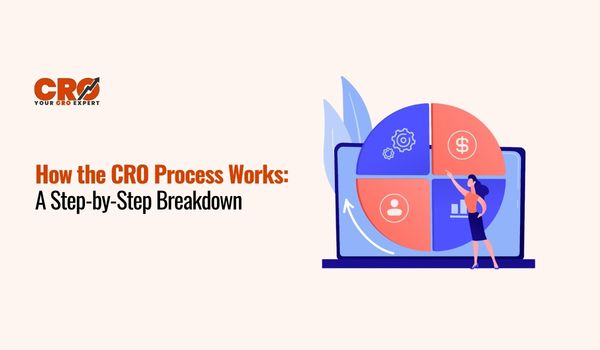
The CRO process (Conversion Rate Optimization process) is a structured method used to improve your website so that more visitors take action, whether that’s making a purchase, filling out a form, or booking a consultation.
CRO is not the redesign of everything, it is rather the little, significant enhancements on the basis of actual facts. It will make you know what is holding back the users to converting and how to eliminate them. something we explain in detail in our CRO guide.
The idea is to make it easier to perform without necessarily increasing traffic.
Even minor adjustments will produce recognizable increases in revenue and leads when performed on a regular basis.
Step 1: Set Clear Conversion Goals
Before you optimize anything, you need clarity.
Ask yourself: what action truly matters for your business?
There are two main types of conversions:
- Macro conversions – Primary business goals such as purchases, demo bookings, or paid subscriptions.
- Micro conversions – Smaller actions like email signups, adding a product to the cart, or downloading a guide.
If you don’t define clear goals, your CRO process will lack direction. Instead of saying, “We want more sales,” set a measurable goal like increasing checkout conversions from 2% to 3% in the next quarter.
Clear goals keep your optimization efforts focused and measurable.
Step 2: Conduct a Proper Conversion Rate Audit
This is where many businesses skip steps and that’s a mistake.
A strong conversion rate audit helps you understand what’s really happening on your website. You’re looking for patterns, not assumptions.
Start by analyzing your key pages. Look at traffic sources, bounce rates, exit pages, and funnel drop-offs. If users are leaving at a specific stage, that’s a sign of friction.
But numbers only tell part of the story.
To truly understand behavior, you need insights from multiple tools for CRO. These tools help you see how users scroll, click, and interact with your pages. Heatmaps, session recordings, and short feedback surveys often reveal usability problems that analytics alone won’t show.
The purpose of this step is simple: identify what’s stopping users from converting.
Step 3: Identify High-Impact Opportunities
Once you complete your conversion rate audit, you’ll begin to see clear opportunities.
Maybe users abandon the checkout form because it’s too long. Maybe your pricing page feels confusing. Maybe your CTA button isn’t noticeable enough.
Instead of trying to fix everything, prioritize pages that directly affect revenue:
- Homepage
- Landing pages
- Pricing page
- Checkout page
Improving a high-traffic page can significantly increase your website conversion without adding new visitors.
Focus on changes that reduce friction, improve clarity, and build trust.
Step 4: Build a Strong Hypothesis
The Conversion Optimization process is not about random changes. Every improvement should be based on a clear concept.
A simple structure works best:
If we change X, then Y will happen because Z.
For example, if you shorten a checkout form, you might expect more users to complete purchases because the process feels faster and easier. Or if you add testimonials near your call-to-action, conversions may increase because trust improves at the decision stage.
This structured thinking keeps your CRO process organized and prevents unnecessary experimentation.
Step 5: Run A/B Tests the Right Way
Testing is where ideas turn into results.
A/B testing compares two versions of a page, the original and a variation to see which performs better. Instead of guessing, you let real users decide.
You can test elements like:
- Headlines and value propositions
- CTA wording and placement
- Page layout or product descriptions
- Images and trust badges
The key is to test one meaningful change at a time. When too many elements are modified at once, it becomes impossible to understand what actually improved performance.
Also, let tests run long enough to collect reliable data. Ending experiments early can lead to misleading conclusions.
The purpose of testing isn’t to confirm your opinion, it’s to discover what works.
Step 6: Analyze Results Carefully
Once the test is complete, review the data with patience.
Did conversions increase? By how much? Was the result consistent?
There are usually three outcomes:
- The variation performs better → Implement it.
- There’s no clear difference → Refine your hypothesis and test again.
- The original performs better → Keep it and try a new approach.
Every result teaches you something. Even when a test doesn’t “win,” it adds insight to your ongoing CRO process.
Document what you tested and why. Over time, this creates a knowledge base that strengthens your future decisions.
Step 7: Implement, Monitor, and Repeat
When a variation clearly improves performance, apply it permanently. But don’t stop optimizing.
Consumer behavior changes. Competitors evolve. Expectations increase.
To consistently increase your website conversion, optimization must become a regular habit, not a one-time project.
Run periodic conversion rate audits, continue using multiple tools for CRO, and keep refining your user experience.
Small improvements each month can lead to major growth over time.
Final Thoughts
The CRO process isn’t complicated, but it requires consistency and discipline. It’s about understanding your users better than your competitors do and removing the obstacles that stop them from taking action.
If you want meaningful results, remember these core principles:
- Clarity converts better than creativity.
Make your value proposition obvious. Users shouldn’t have to “figure out” what you’re offering. - Data should guide every decision.
A proper conversion rate audit prevents emotional or opinion-based changes. - Optimization is a long-term strategy.
The Conversion Optimization process works best when testing becomes continuous. - Small lifts create big impact.
Moving from a 2% to a 3% conversion rate might sound small, but that’s a 50% improvement in results. - User experience always comes first.
Faster pages, shorter forms, clearer CTAs, these practical improvements often outperform major redesigns.
At the end of the day, growth doesn’t always come from more traffic. It often comes from smarter optimization.
Start with one page. Run one structured test. Learn from it.
That’s how you truly increase your website conversion steadily, strategically, and sustainably.